
Muslims Tried To MASS MIGRANT Into Poland, Then Get REJECTED at The Border!…

The Polish Fortress: Inside Europe’s Last Stand Against Mass Migration
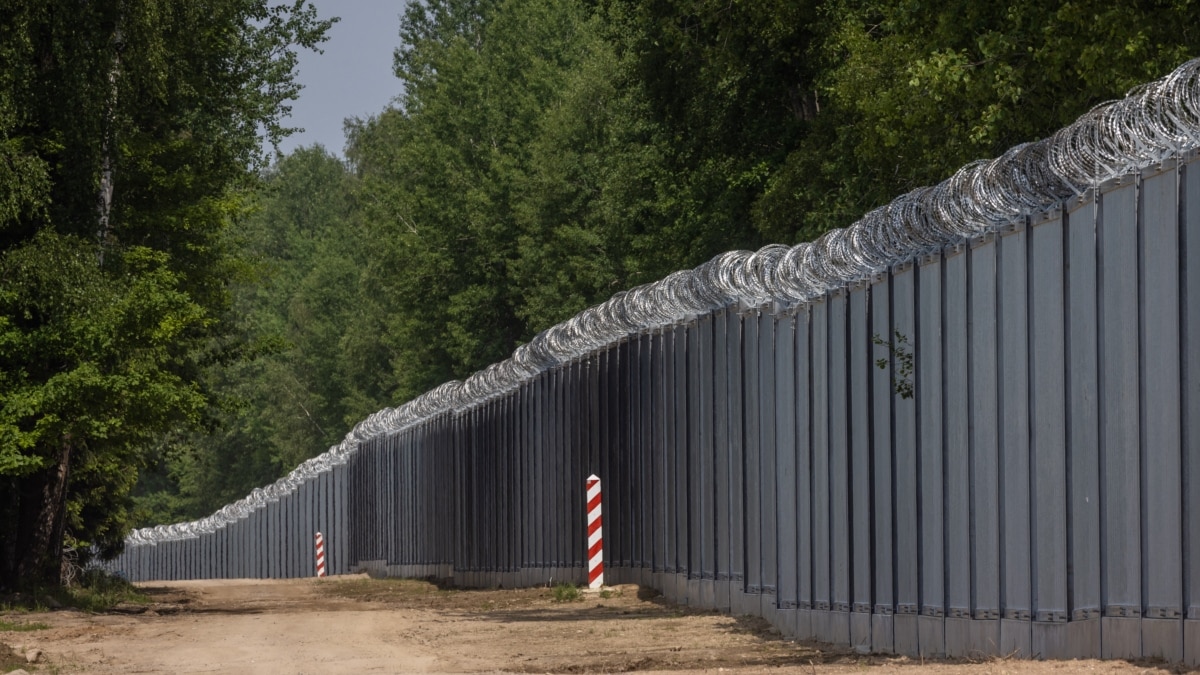
Along the dense, emerald stretches of the Białowieża Forest, the silence of the European frontier is broken not by the rustle of wildlife, but by the rhythmic clanging of steel.
Here, a massive, sophisticated wall of metal and sensors cuts through the landscape—a physical manifestation of a nation’s refusal to bend.
Firebrand Member of the European Parliament, his voice echoing a sentiment that has turned Poland into the ideological lightning rod of the continent.

“You know why?
Because there are zero terrorist attacks in Poland.
Why?
Because there is no illegal migration in Poland.”
For many Americans, viewing the European migrant crisis through the hazy lens of international news, Poland’s stance can seem jarring, even archaic.
But for the Polish people, and an increasing number of Western observers, the “Polish Model” isn’t about bigotry—it’s about the fundamental survival of a sovereign cultural identity in an era of global flux.
The Architecture of Rejection
To understand Poland’s current defiance, one must look at the statistics that Tarczyński and his supporters wield like shields.
In a European Union where migration has become the primary driver of demographic change, Poland remains one of the most religiously and ethnically homogeneous nations on Earth.
Over 90% of the population identifies as Roman Catholic.
The Muslim population remains a microscopic fraction, estimated at less than 0.1% of the total citizenry.
This homogeneity is not an accident of geography; it is a policy of the state.
While Germany opened its doors to over a million refugees in 2015—an event many Poles view as the catalyst for the current “Islamification” of the West—Poland effectively slammed its doors shut.
The results, according to the Polish government, speak for themselves.

While France and Sweden have seen spikes in violent crime and the rise of “no-go zones,” Poland boasts some of the lowest crime rates in the EU.
According to Eurostat data from 2024 and 2025, Poland’s unemployment rate consistently hovers near the bottom of the European average, while its GDP growth has outperformed nearly all of its Western neighbors in the post-pandemic era.
“They look at Islam as a foreign ideology that doesn’t align with their values,” says Sahar, an independent commentator whose viral videos have brought the Polish border struggle to a global audience.
“The establishment and the people of Poland are not ‘acceptable’ of Islam because they see what has happened elsewhere.
They see the lack of integration.
They see the tension.”
The Border as a Battleground
The conflict isn’t just rhetorical; it is visceral and physical.
At the border with Belarus, Polish soldiers stand in a permanent state of readiness.
The “migrant crisis” here is widely viewed as a “hybrid war” orchestrated by foreign adversaries to destabilize the EU.
Videos circulating on social media show a stark reality: groups of young men, mostly from the Middle East and Africa, attempting to breach the fence, only to be met with the cold efficiency of Polish security forces.
The footage is often brutal.
Migrants cry out in frustration, claiming they were promised a “good life” in Europe, only to find themselves trapped in a frozen no-man’s-land.
“They said if I go to Poland they will hit me or they will kill me,” one migrant screams into a camera lens in a recent dispatch.
To the Polish authorities, these are not “refugees” in the traditional sense, but “fake asylum seekers” being used as pawns.
The message from Warsaw is clear: if you try to enter illegally, you will be stopped.
If you bypass the law, you forfeit the welcome.
A Clash of Civilizations or Common Sense?
The debate over Poland’s tactics often boils down to a fundamental disagreement over the nature of a nation-state.
To the “Progressive Left” in the European Parliament, Poland is a “pariah state” violating human rights and failing its “European duty.”
To Tarczyński and his base, the “Leftists” are the ones who have failed—by sacrificing the safety of their own citizens on the altar of multiculturalism.
“Polish nation rejected you, dear Leftists, eight times in a row,” Tarczyński declared in a recent parliamentary session, referring to the string of electoral victories for conservative and nationalist platforms.
“Do not teach us about democracy.
We know what democracy is.
Learn from Poland.
Be like Poland.”
This “Be like Poland” movement is finding an unexpected audience in the United States and the United Kingdom.
As the U.K. struggles with its own “small boats” crisis in the English Channel, and as American border towns face unprecedented surges, the Polish approach of “put them on a plane and send them back” is gaining traction among those disillusioned with liberal immigration policies.
The argument is centered on integration.
Critics of mass migration point to the lack of assimilation in Western European suburbs as a cautionary tale.
In Poland, the cultural consensus is that the burden of integration lies solely with the newcomer.
“Have you ever seen Jews doing [disrespectful acts] in Poland?” Sahar asks in his commentary.
“You haven’t seen that because we integrate.
That’s the difference.
[The migrants] don’t approve of you.
You’re a ‘kufar’ (infidel) to them.”
The Economic Miracle Behind the Wall
Beyond the cultural friction lies a hard economic reality that many Western critics find difficult to ignore.
Poland is no longer the “poor cousin” of Europe.

By maintaining social cohesion and avoiding the massive social welfare costs associated with large-scale irregular migration, Poland has reinvested in its own infrastructure and industry.
The data supports the boast:
Safety: Poland consistently ranks as one of the safest countries in the world for women to walk alone at night.
Growth: Its economy has transitioned from a post-communist struggle to a high-tech hub, often referred to as the “Texas of Europe.”
Identity: A sense of national pride that is increasingly rare in the globalized West.
For Dominic Tarczyński, the PhD lawyer and politician, this isn’t about hate—it’s about “surviving.”
“I’m a proud European, proud Christian,” Tarczyński told a British interviewer.
“I want Europe to be a Europe, not an Asia, Africa, or any other continent.
I do not want to lose my identity…
You do not want people who want to change your legal system to Sharia.
You do not want people who want to change your culture.”
The Warning to the West
As 2026 unfolds, Poland stands as a living experiment in national sovereignty.
It is a country that has decided that the “fancy way of living” promoted by globalist elites is a secondary concern to the physical and cultural protection of its families.
The Polish message to the world—and specifically to Americans watching their own borders—is one of urgency.
They argue that the time for “debating” and “theories” ended in 2015.
“Protect yourself,” Tarczyński warns.
“So many people are killed, raped, stabbed.
How long can you wait?
How many must suffer until someone will take action?”
Whether one views Poland as a xenophobic fortress or a beacon of common-sense survival, its influence is undeniable.
While the rest of the continent wonders how to fix the cracks in its foundations, Poland is busy reinforcing its walls.
In the eyes of the Polish people, they aren’t the ones who are lost; they are the only ones who have found their way home.
And as long as there are “zero” attacks on their soil, they have no intention of changing course.
“Your weapon is your voice,” Tarczyński says, a call to action for every Westerner who feels their culture slipping away.
“It’s time to fight.”


